Buy/Lease an Electric or Hybrid Vehicle
Summary: Drive Electric
Description
Why drive an EV (electric vehicle)? EVs are less expensive to operate and maintain than fuel cars (say goodbye to oil changes), and they are fun to drive! Also, you can conveniently charge your car at home, or at the growing number of charging stations in Massachusetts and beyond — so no more stops at gas stations. Plus, there are a lot of great choices on the market now; check out the many options to buy through Drive Green and lease through PlugStar.
Most importantly, driving an EV is one of the most impactful ways to reduce your emission of greenhouse gasses and harmful pollutants. For those subscribed to the Standard option of Acton Power Choice (the Town's electricity supply program), the average reduction from each switch from a gas-powered vehicle to an EV is approximately 2.6 tons/year of CO2 equivalent. Your individual impact will depend on the particular car model you drive, how much you drive, and other factors.
If the electricity that powers the EV is generated by renewable, carbon-free sources, then you have taken an even bigger step to limit emissions, totaling approximately 4 tons per vehicle on average. (See Franklin’s 100% green electricity option, Franklin Community Choice Power Supply Program FCCPSP) Electrifying your ride is the biggest single step most families can take to support Franklin's mobilization to achieve net zero carbon emissions.
Common Terminology (all those funky acronyms)
BEV: Battery Electric Vehicle. Powered completely by an electric battery that requires plug-in recharging. Also called an EV or Electric Vehicle. 23 BEVs qualify for a $3500 rebate via Massachusetts' MOR-EV Program. For a list of eligible vehicles and further details, please visit MOR-EV.ORG by clicking here.
PHEV: Plug-in hybrid electric vehicle. Plug-in hybrids are part electric and part gasoline. It uses a larger battery that is charged with a 120-volt or 240-volt outlet. Once the battery depletes, a PHEV drives much like a conventional hybrid car. 15 PHEVs qualify for a $1500 rebate via Massachusetts' MOR-EV Program. For a list of eligible vehicles and further details, please visit MOR-EV.ORG by clicking here.
HYBRID: A hybrid vehicle combines at least one electric motor and battery with a gasoline engine to power the car, and its system recaptures energy via regenerative braking. A hybrid vehicle typically runs on electric power until the battery is nearly depleted, and then the car automatically switches over to use the Internal Combustion Engine. There are no plug-in capabilities.
ICE: Internal Combustion Engine: typically runs on gasoline or other combustible materials. The only battery on an ICE engine powers the lights and the starter etc.
How much does an EV cost? There is a broad range of EV pricing, as is true for gas-fueled vehicles. However, there are significant rebates available through the State of Massachusetts ($1,500–$3,500), as well as federal tax credits. On top of this, Drive Green, a program of the Boston-based Green Energy Consumers Alliance, saves even more. Drive Green arranges, with Massachusetts car dealerships, provision of very substantial discounts on the purchase or lease of many brands and models of EVs. These deals change every month, so be sure to check often. There is more information on costs and savings under the Deep Dive tab.
Want to lease? Many drivers do opt to lease electric cars because the technology improves every few years. As noted, PlugStar offers substantial discounts on leasing through local car dealerships. If you lease a car, the leasing company gets the federal tax credit, which is why several dealers are offering very attractive leasing options.
From costs to maintenance to environmental stewardship, there are many great reasons to switch to EVs!
Deep Dive
Emissions Benefits. In Massachusetts, transportation accounts for 43% of our greenhouse gas emissions. Switching to EVs, especially in combination with accessing renewable, carbon-free electricity, can dramatically reduce our greenhouse gas emissions. EVs have lower lifecycle emissions than gas-powered cars, even after accounting for extra emissions from battery manufacturing.
If the electricity to charge an EV comes from fossil fuels, driving an EV is obviously not entirely emissions free. Still, according to the Union of Concerned Scientists, EVs and plug-in electric-gas hybrids have much smaller carbon footprints than conventional ICE (internal combustion engine) cars — no matter the source of the electricity. (See this article from the Washington Post on why electric cars are better for the environment and also this article from the Union of Concerned Scientists.)
There are a lot of great choices on the market right now, from all-electric vehicles to electric–gas hybrids with plug-in options. EVs have great pickup and are less expensive to operate than ICE vehicles. For example, in 2019, New York City “spent between $204 and $386 maintaining each of its electric cars, compared to more than $1,600 for the average gasoline-powered car”, according to Electric vs. Gas: Is It Cheaper to Drive an EV? by NRDC (Natural Resources Defense Council). EVs have fewer moving parts and are therefore much cheaper to maintain: they do not need oil changes, and have no transmission fluids, fuel pumps, timing belts, exhaust systems, or other typical gas-powered auto parts.
Range anxiety? Fully electric vehicles (EV) are constrained by their battery capacity, but battery range is improving by the year. For example, the new, highly rated Chevrolet Bolt has a range of about 259 miles. The Tesla Model 3 has a range of 250–322 miles, depending on the model.
The local and national network of charging stations keeps expanding, with many apps that help you locate public charging stations and track availability in real time. Most chargers are located conveniently at transit stops or roadside rest stops; in addition, many parking lots, places of employment, and hotels have also installed chargers. Plugshare is one app that finds charging stations anywhere you are going. EVgo is another, and lists fast-charging stations. ChargeHub is yet another that can help you plan long trips with EV charge stops along the way. ChargePoint offers many stations in the greater Boston area.
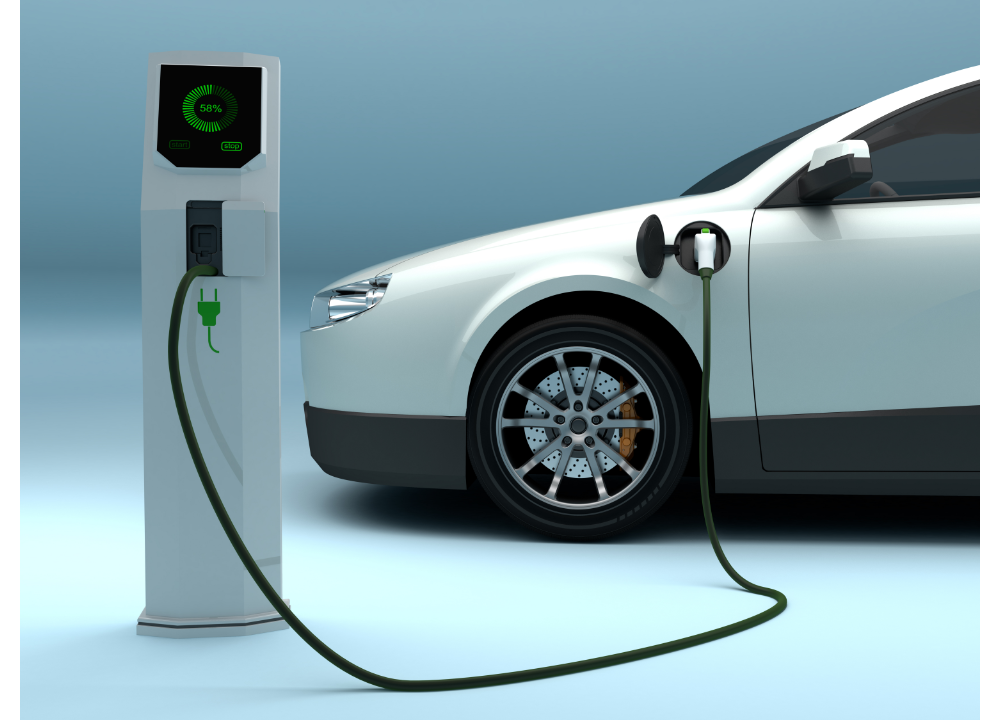
Charging an EV. You can plug your EV into any standard 110-120V outlet (known as “trickle charging,” but many EV and plug-in owners install a Level II 240V charger at home, which speeds up charging time roughly sixfold. This can be installed in a garage or attached to a home or building, close to where the car is parked. For home installation, the charger itself, plus installation by an electrician, may cost approximately $1,000–$1,200. This cost is tax deductible, and there may be incentives from the state or utilities. (The fastest charging option is DC charging, which uses direct current, and for most EVs, requires a different charging nozzle from the one that works for Level I and Level II charging.) National Grid also offers a rebate program for residential EV charging station installations. You can find out more about that program on their website here.
State & Federal Rebates. Qualifying battery electric vehicles and fuel cell electric vehicles are eligible for a $3,500 Massachusetts rebate for cars and $7500 rebate for 4 models of trucks (Chevrolet, Ford & Rivian) , a van (Ford E-Transit) and an SUV (Rivian R1S). Rebates are subject to a $55,000 MSRP (Manufacturer’s Suggested Retail Price) cap for cars and $80,000 for the trucks, Ford van and Rivian SUV. For 2024, PHEV or Plug-in hybrid electric vehicles no longer qualify for a Massachusetts rebate. Some electric vehicles qualify for federal income tax credits, as well. New for 2024, buyers can direct their $3750 or $7500 rebate directly to the dealer at the time of purchase or lease. Rebate rules are more stringent for buying than leasing. Fourteen manufacturers have cars eligible for the Federal rebate for leasing versus only seven for buying. Consumer Reports summarized the new landscape for Federal Rebates as of 5-1-24:
To qualify for a Massachusetts rebate, your application must be filed within 3 months from date of purchase or lease. Also, you must retain ownership or lease for a minimum of 3 years as shown via your vehicle registration. Rebate checks are typically issued within 2 months of application acceptance. For a list of eligible vehicles and further details, please visit MOR-EV.ORG by clicking here. MOR-EV rebates are processed on a first come, first serve basis meaning when the allocated funds are used up, the program ends unless more funds are allocated by the legislature. Read the MOR-EV FAQs here.
You can also calculate your potential federal rebate with Rewiring America’s IRA calculator. And you can learn more with their IRA guide.
How important are electric vehicles for meeting Franklin’s net zero carbon goal?
For most Franklin families, switching one car to electric is expected to cut about 2.6 tons (MTCO2e) every year from their carbon footprint (depending on the particular car models before and after the switch, and with APC Standard electricity). Switching 2 cars to electricity beats any other single action.
Steps to Take
- Go to Drive Green and browse through the latest available discounts on EVs.
- Research other cars with the PlugStar "Browse Electric Cars” tool. This interactive online guide of models can help you decide which vehicle is right for you through your answers to a few questions about: (1) how many miles you drive per day; (2) what type of long trips you make; and (3) how much passenger and cargo space you need.
- Check out what other EV drivers say and read the "Testimonials" tab on this site (see above). If you are already an EV driver, please write a Testimonial now!
- Test drive some EVs at the dealerships. (This is the most enjoyable step!)
- Once you know which models you’re interested in, check back with Drive Green to review current deals. Also, don't assume the dealers will automatically offer you these deals — you need to “bring the deal to the dealer.” (Handy benefit: you can skip the sales pitch by showing the unbeatable Drive Green deal.)
- Consider a charging station for your home for greatest convenience. See Drive Green for detailed info on charging stations. Watch for substantial state or utility rebates and incentives for installing chargers. This is an important step, as public charging infrastructure and availability are growing, but currently limited in some areas.
- Let us know how it went by leaving a Testimonial under the tab above.