EV love after seven years and 80,000 miles
User: randkbarthel@gmail.com
Vendor: Drive Green - Green Energy Consumers Alliance
Action: 3344 - Buy/Lease an Electric or Hybrid Vehicle
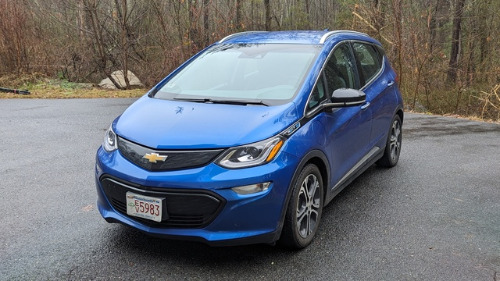
In July 2017 my wife and I took the EV plunge and purchased a bright blue Chevy Bolt Premier, which was at that time the only fully electric car that we could both afford and walk into a showroom and buy. At that time the Tesla Model 3 was still about a year away from kick-the-tires availability. What’s it like to live with an electric car as your primary vehicle? And how has the EV market changed since 2017? Read on.
We had decided that our next car would be electric, but with one model to pick from, would it actually meet our needs? After 80,000 miles, we can answer with a resounding YES. The Bolt is a compact but roomy hatchback with zippy acceleration, crisp handling, and enough room for four tall adults to sit comfortably. It has a lot of cargo space with the back seat folded down. Seven years later, we both still love to drive it.
You don’t “start” an electric car, you “turn it on”. There’s a whirring noise instead of the rumble and vibration of an engine. There’s a shift selector with P,R,N,D,L like in a traditional automatic transmission car, but there is only one forward “gear”. That’s because electric motors have full torque from zero RPM. They don’t need to “shift gears”. The accelerator pedal gives precise control of torque like you can get in a manual transmission car, but without having to use a clutch.
The Bolt is not fast by electric car standards, but acceleration is instant, strong, smooth, and linear in a way gas cars can’t be because they have to shift gears. There is no engine noise or vibration. The Bolt can do 0-60 mph in about 7 seconds. You have to be careful on the highway, because acceleration feels so effortless.
The Bolt has regenerative braking, as do other EVs and hybrid cars like the Toyota Prius. When you press the brake pedal, the drive motor becomes a generator, turned by the wheels, that charges the battery. You can control regenerative braking with the brake pedal or by squeezing a hand paddle that’s behind the steering wheel. Electric drive and regen braking make the Bolt a very efficient car for urban stop-and-go driving: you don’t waste energy idling, and you get a lot of it back every time you have to slow down. There are friction brakes, but they are mostly for safety.
Range and charging are the things that worry people most about electric cars. The bolt’s 66 kilowatt-hour (kWh) battery gives it a range of 250+ miles in the summer and 180-200 in the winter. This puts eastern Massachusetts, southern New Hampshire, Rhode Island, and western Massachusetts as far as Springfield within our round-trip range.
The most important thing about charging is, If you can charge at home, it’s a non-issue 95% of the time. The same is true if you have a way to charge when the car is parked during your workday. To make this work, you need a Level 2 (240-volt AC) charging station where the car will be parked. We have ours in our garage, but it can be outside if you don’t have a garage. This needs a 240-volt, 40-amp circuit such as you would use for an electric dryer. Installing this is an extra expense, but these days it is often included in the price of a new EV. A Level 2 charger can charge a Bolt all the way from empty in about nine hours. This enables you to start every day with a full battery.
You can charge a Bolt with an ordinary 120-volt extension cord. This is called Level 1 charging. It will only put about 4 miles of range into the battery in an hour. Some people with short commutes are able to make this work by keeping the car plugged in all the time when it’s not in use.
If you venture beyond your home radius, you will need to charge at a commercial DC fast charging station (also called Level 3). These belong to one of several nationwide charging networks. In the Northeast the main ones are Electrify America, ChargePoint, and EVgo. You use cell phone apps to find charging stations and, in some cases, to operate them. Each network has its own app, and then there are trip-planning apps like A Better Route Planner (ABRP) and ChargeHub that can plan a road trip with charging stops. Charging stations are found in shopping centers, restaurants, car dealerships, and highway rest areas.
The charging network has grown a lot since we bought our car, but it still has its problems. Charging stations are often down for maintenance, and sometimes they get backed up with people waiting to charge. Tesla, which has the most reliable charging network in the industry, is in the process of opening its network up to non-Tesla EVs, which will make the on-the-road charging situation much better. The Federal Infrastructure Act and Inflation Reduction Act should go a long way toward beefing up the charging system.
We have driven our Bolt as far as Arlington VA, Rochester NY, and Saco ME. Road trips are doable, but they do take longer and require more planning than they would in a gas car. (You try to plan charging stops to coincide with meals or other stops you would be making anyway.) A lot of this is due to the Bolt’s slow DC charging. Newer EV designs can charge three times as fast as the Bolt, and some even faster.
Another important question is economics. EVs have historically cost more to buy than equivalent gas cars, but EV prices have been trending downward lately. The $7500 Federal tax credit for EVs meeting certain made-in-America requirements can help. EVs have low maintenance costs: there’s no oil to change, and brake pads and rotors last a long time due to regenerative braking. Our Bolt gets about 4 miles per kWh of electricity. Even with our region’s very high electricity prices (32 cents per kWh in Mendon), that works out to a very competitive 8 cents per mile “fuel” cost. A gas car that averaged 35 mpg on $3.50 per gallon gas would cost 10 cents per mile.
Of course, if you have solar panels as we do, then the economics get even better because some, most, or maybe even all of your electricity is free.
Conclusion: our experience is that even in a region with high-cost electricity, an electric car can be a practical, economical form of personal transportation that is much less harmful to the climate and environment than an equivalent gas car. And they’re fun to drive!